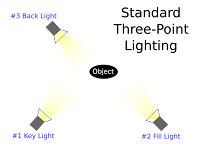
There are three lights used to achieve this setup:
- Key Light
- Fill Light
- Rim Light (also called the back light)
All of these lights are adjusted to achieve the classic Hollywood lighting scheme called three-point lighting.
The Key Light creates the subject's main illumination and defines the most visible lighting and shadows. Your key light represents the dominant light source, although, the key light does not have to be positioned exactly at this source.
The purpose of the Fill Light is to soften and extend the illumination provided by the Key Light, and makes more of the subject visible. Fill Light can simulate light from many secondary light sources and reflect them to bounce light into your scene.
The Rim Light (also called Back Light) creates a bright line around the edge of the object to help visually separate the object from the background.
Wednesday, August 1, 2012
Sunday, July 22, 2012
Converting Kodak Zi8 Files For Use in iMovie and Final Cut
1. Select this icon from your applications folder or the Dock:

2. To open a video file, simply drag it into the centre of this window


3. On the top menu select: File
Then select: Export to Quicktime

4. Ensure you match these settings:
- Apple Intermediate Codec
- Frame Size: 1280x720
- Select Make Movie
- Rename the File
- Save the new file on your USB or Hard Drive

5. Open Final Cut from the Dock by selecting this icon

The Final Cut Interface:

6. Check your project settings. Click on the Browser window and this is where your clips and sequences will later be stored.

7. Go to the file menu and select easy setup

8. Set your project Format to Apple Intermediate Codec with a Rate of 29.97 fps. Use the exact options indicated below:

2. To open a video file, simply drag it into the centre of this window
3. On the top menu select: File
Then select: Export to Quicktime
4. Ensure you match these settings:
- Apple Intermediate Codec
- Frame Size: 1280x720
- Select Make Movie
- Rename the File
- Save the new file on your USB or Hard Drive
5. Open Final Cut from the Dock by selecting this icon
The Final Cut Interface:
6. Check your project settings. Click on the Browser window and this is where your clips and sequences will later be stored.
7. Go to the file menu and select easy setup
8. Set your project Format to Apple Intermediate Codec with a Rate of 29.97 fps. Use the exact options indicated below:
Sunday, June 3, 2012
Classwork!
Today in class, I have been revising for our up-coming test on friday. I have been going through notes on miss-on-scene, cinematography and sound and editing. Our test mainly focuses on the work we were doing in term 1 and some of the work we have been doing this term. My main resources are from blackboard, nots on my blog and many power points. I will be very excited when this test is over, as then I can concentrate on my assessment, which is producing a film. This is due at the end of next term. I am working in a group of 4 people to help produce this film. I have already created the storyboard, organised the characters and done my film synopsis. I am very excited for next terms work, producing the film.
Friday, June 1, 2012
Storyboard Recipe!
Ingredients:
4x beautiful princesses
1x unfaithful prince charming
1x dark, gloomy forest
1x beautiful church
1x relaxing park
1x oak tree
1x flash back
Black Screen
Various objects
Blood
Tense Music
Credits
Bloopers
Recipe:
Take 4 beautiful princesses and place them in the forest running. Place the unfaithful prince charming in front of them, so that the princesses are chasing after the prince. Place the various objects in the princesses hands and make them start throwing the various objects at the prince, whilst he is running for his life. Add the flashback in and make the princesses appear at the beautiful church and marry the same prince to show that he is unfaithful. Throw in the next part of the flash back when the princesses are all at the park and suddenly see the prince emerging. When they all go to greet him, they discover the truth and are angry about his disloyalty. Then, show the four princesses chasing after the prince again in the forest. Add in a point-of-view shot of one of the princesses throwing heels at the prince, whilst running hurriedly after him. Take the camera back to show the princesses wanting to take revenge on the prince and show a full body shot of him rapidly turning around to face the princesses accepting that they are about to kill him. Supplement a black screen in, so that the audience can only hear the sound of fighting. Show the image again and make one of the princesses kill everyone, instead of just the prince. Move the camera to show an over-the-shoulder shot of the surviving princess writing in blood on the oak tree the words, "Happily Ever After." Have tense music playing in the background and illustrate her walking off smiling and chuckling to herself. Show the credits appear on screen and add the bloopers in afterwards.
4x beautiful princesses
1x unfaithful prince charming
1x dark, gloomy forest
1x beautiful church
1x relaxing park
1x oak tree
1x flash back
Black Screen
Various objects
Blood
Tense Music
Credits
Bloopers
Recipe:
Take 4 beautiful princesses and place them in the forest running. Place the unfaithful prince charming in front of them, so that the princesses are chasing after the prince. Place the various objects in the princesses hands and make them start throwing the various objects at the prince, whilst he is running for his life. Add the flashback in and make the princesses appear at the beautiful church and marry the same prince to show that he is unfaithful. Throw in the next part of the flash back when the princesses are all at the park and suddenly see the prince emerging. When they all go to greet him, they discover the truth and are angry about his disloyalty. Then, show the four princesses chasing after the prince again in the forest. Add in a point-of-view shot of one of the princesses throwing heels at the prince, whilst running hurriedly after him. Take the camera back to show the princesses wanting to take revenge on the prince and show a full body shot of him rapidly turning around to face the princesses accepting that they are about to kill him. Supplement a black screen in, so that the audience can only hear the sound of fighting. Show the image again and make one of the princesses kill everyone, instead of just the prince. Move the camera to show an over-the-shoulder shot of the surviving princess writing in blood on the oak tree the words, "Happily Ever After." Have tense music playing in the background and illustrate her walking off smiling and chuckling to herself. Show the credits appear on screen and add the bloopers in afterwards.
Wednesday, May 30, 2012
Vampire Film Synopsis!
We see the priest leaning against what
appears to be a rail in a large, open building. The building appears to be a
church. We can tell from his body language that he is frightened, as he is
leaning back and his whole body seems to be tensed as fear. From the left of
the frame, the vampire emerges moving ominously and creepily towards the
priest. It is a low-angle, mid shot and also an over-the-shoulder shot. We hear
the sound of the vampire’s feet creaking against the floorboards and the
priests breathing starts to become heavy, tense and quite loud.
We cut to a point of view shot from the
priest’s perspective with the vampire looking down on the priest hungrily. The
vampire appears to be wearing a formal jacket that looks quite dirty and old,
with a striped tie and a white loose shirt underneath. His hair is very scruffy
and unclean. We can see that his facial expressions are very serious and scary
and his eyes show a lot of evil in them. Sounds of the wind howling are heard
in the background of the shot.
The audience then sees a tracking shot of
the priest moving from right to left across what appears to be a barrister on a
balcony of a church. He is leaning right against the rail, illustrating that he
is scared and wants to stay as far away as possible from the vampire. As he
moves along the barrister, his hands are tightly gripped to the piece of wood,
which shows that he is very tense and frightened. We can see the vampire
appearing in the background, moving menacingly forward toward the priest in a
steady, stiff manner. All the audience can hear is the moans from the priest
who is frightened and his footsteps along the wood as he moves further and
further away. It is a mid shot. The shot then cuts and we see the vampire
launch himself off the balcony flinging the priest down onto the altar, which
is on the lower floor of the church. The alter candles are flung in disarray
and the two men’s bodies appear to be lifeless. The camera zooms out from the
two bodies lying on the alter table and the vampire starts to feed on the
priest. We hear the sound of the balcony snapping as the vampire launches
himself onto the priest and then the sound of the loud thump from the two men
landing on the altar. The audience can also hear the sound of many items near
the altar, where the ten men landed, shatter apart. It is portrayed as a
high-angle, mid-shot.
The camera zooms out slowly for the rest of
the film. It is a high-angle, mid-shot to a long shot. The audience can see the
priest’s body lying across the alter still. As the camera zooms out, Jesus is
shown hanging on the cross above the priest. Tense music is playing in the
background and the vampire is nowhere to be seen. The shot then cuts to a black
screen and all is quiet.
Notes on Protagonist and Antagonist!
Protagonist drives the plot forward.
Antagonist tries to stop him.
The protagonist is the main character, usually the "good" guy in the story. The story mainly focuses on this character's experiences.
The Antagonist is usually portrayed as the "bad" guy, or the person that goes against the protagonist and way he's trying to do.
In the Story Mind, the Protagonist is the Prime Mover of the effort to achieve the Story's Goal. The Antagonist is the Chief Obstacle to that effort. In a sense, Protagonist is the irresistible force and Antagonist is the immovable object.
Without a Protagonist, your story would have no directed drive. It would likely meander through a series of events without any sense of compelling inevitability. When the climax arrives, the protagonist would likely be weak. This is not to say that the protagonist won't be convinced to stop trying, eventually, he or she will ignite again and once more resume the drive toward the goal.
In choosing which of your characters to assign the role of the Protagonist, it doesn't have to be the most powerful character, rather it will simply be the character who keeps pressing forward, even if in a gentle manner until all the obstacles to success are either overcome or slowly eroded.
Monday, May 28, 2012
Notes on Plot Development!
What is a plot?
A plot is the organised pattern or sequence of events that make up a story. Every plot is made up of a series of incidents that are related to one another.
Exposition:
This usually occurs at the beginning of a short story. Here the characters are introduced. We also learn about the setting of the story. Most importantly, we are introduced to the main conflict.
Rising Action:
This part of the story begins to develop the conflict(s). A building of interest or suspense occurs.
Climax:
This is the turning point of the story. Usually the main character comes face to face with a conflict. The main character will change in come way.
Falling Action:
All loose ends of the plot are tied up. The conflict(s) and climax are taken care of.
Resolution:
The story comes to a reasonable ending.
A plot is the organised pattern or sequence of events that make up a story. Every plot is made up of a series of incidents that are related to one another.
Exposition:
This usually occurs at the beginning of a short story. Here the characters are introduced. We also learn about the setting of the story. Most importantly, we are introduced to the main conflict.
Rising Action:
This part of the story begins to develop the conflict(s). A building of interest or suspense occurs.
Climax:
This is the turning point of the story. Usually the main character comes face to face with a conflict. The main character will change in come way.
Falling Action:
All loose ends of the plot are tied up. The conflict(s) and climax are taken care of.
Resolution:
The story comes to a reasonable ending.
Subscribe to:
Posts (Atom)